Mockup vs. product photography: what converts better?
Every apparel seller eventually asks it: should I pay for real product photos, or are mockups good enough? The honest answer is that it depends on where the image will live — and the sellers who do best usually aren't choosing one side. Here's the breakdown, without the bias you'd expect from a mockup tool (well, mostly — judge for yourself).
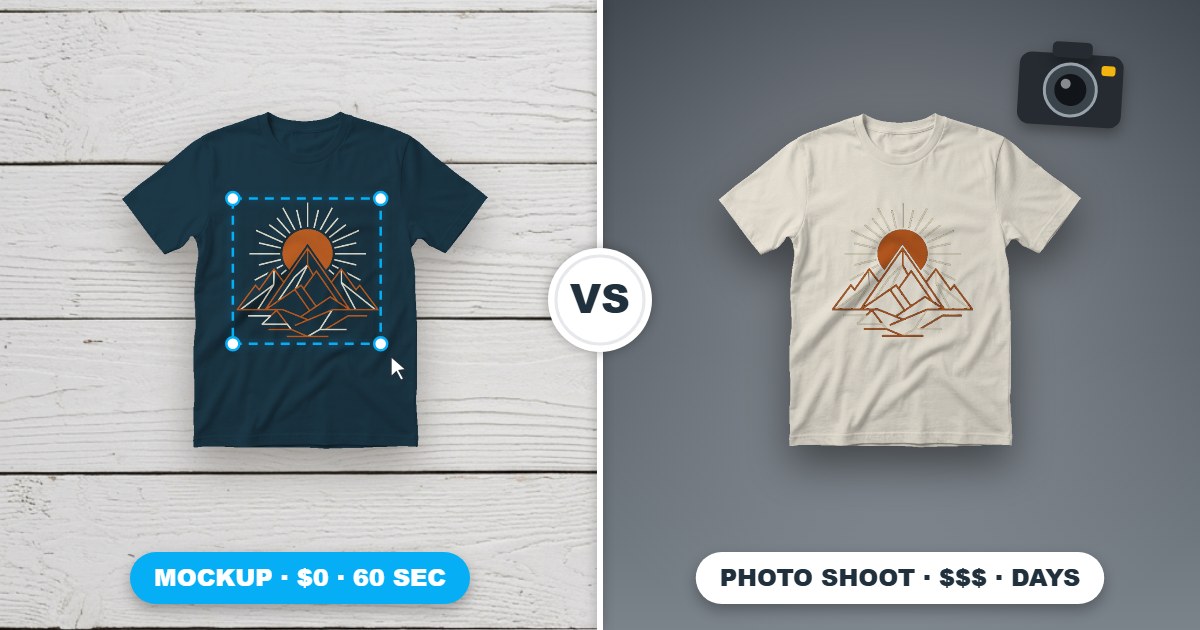
The two contenders, defined
- Mockup: a digital composite — your design placed on a garment photo, like the ones from our free generator. Costs nothing, takes a minute, scales to infinite variants.
- Product photography: a real printed shirt, photographed. Requires ordering a sample, plus either a DIY setup or a photographer. Days of lead time, real money per design.
Head to head
| Mockup | Product photography | |
|---|---|---|
| Cost per design | $0 | Sample + shoot: tens to hundreds |
| Turnaround | About a minute | Days to weeks (sample shipping + shoot) |
| Scales to variants | Every color and garment in seconds | Each variant is another sample + shot |
| Shows real fit & drape | Approximates it | Yes — its biggest advantage |
| Human connection | No faces, no story | Models and lifestyle context build trust |
| Consistency across a catalog | Perfectly uniform | Depends on the photographer's discipline |
Where mockups convert just as well (or better)
- Marketplace search grids. At Etsy/Amazon thumbnail size, a clean flatlay mockup and a professional photo are functionally identical — clarity and contrast decide the click, not photographic authenticity. (Our Etsy listing photo guide covers thumbnail rules in depth.)
- Unvalidated designs. Most new POD designs never sell a unit. Spending $50–150 photographing each one is negative ROI by definition; mockups let you test 50 designs for the cost of zero shoots.
- Large catalogs. A 200-design shop with photography for everything either has a serious budget or seriously inconsistent images. Mockups keep every listing uniform — which itself reads as professionalism.
Where real photography wins
- Fit-sensitive garments. Fitted cuts, heavyweight fabrics, oversized streetwear — drape is the product, and only a real photo (ideally on a body) shows it.
- Brand stores and premium pricing. On your own Shopify site charging $40 a tee, lifestyle photography with real people justifies the price in a way composites don't.
- Ads and social. Faces stop thumbs. UGC-style photos of a person wearing the shirt reliably outperform product-only images in paid social.
- Social proof. Customer photos in reviews are photography you didn't pay for — and the most trusted images in the whole funnel.
The hybrid playbook (what experienced sellers actually do)
- Launch everything with mockups. Full listings, all variants, correct placement — zero photography spend.
- Let sales vote. After 30–60 days, a handful of designs will separate from the pack.
- Order samples of the winners only. Shoot them — a phone by a window is enough to start — and add the photos alongside the mockups.
- Recycle customer photos (with permission) into listings and ads as they arrive.
The mockup pays for the photography, in other words. The two aren't competitors in a real workflow — they're stages.
One warning for each side
- A bad mockup is worse than none: floating prints, wrong garment, or a watermark screams low effort. Use accurate placement and a tool that blends the print into the fabric — and never ship a watermarked "free" download.
- A bad photo is worse than a good mockup: dim lighting, wrinkled shirt, cluttered background. If you can't shoot it well yet, the mockup is the more professional choice.
Frequently asked questions
Do mockups convert worse than real product photos?
Not in marketplace search grids — a clean, accurate mockup performs on par with photography at thumbnail size. Real photos pull ahead where trust and fit matter most: brand stores, ads with people, and premium price points.
Can buyers tell an image is a mockup?
A good mockup with correct placement and fabric blending reads as a product photo at listing sizes. What buyers do notice is a bad mockup — floating prints, wrong garment, watermarks.
Is product photography worth it for print on demand?
Only after a design proves itself. Ordering samples and shooting every design loses money on the ones that never sell; the standard play is to validate with mockups first, then photograph just the proven sellers.
What is the cheapest way to get real photos of my shirts?
Order one sample of a proven design and shoot it in natural window light with a phone — or ask buyers for photos and (with permission) use customer pictures, which double as social proof.
Start with the $0 option
Validate your designs with clean, watermark-free mockups — then let the winners earn their photo shoot.
Open the Free T-Shirt Mockup Generator